
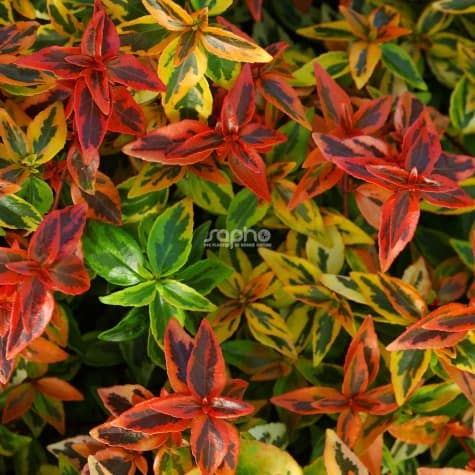
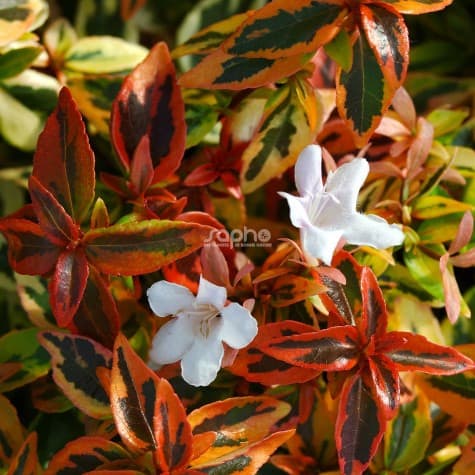
A constantly renewed kaleidoscope, much appreciated by gardeners.
This evergreen shrub with variegated foliage, light green and golden yellow in spring, is coming into young orange coloured shoots turning to scarlet red at the end of summer up to winter. These shades can vary according to the position, climate and type of soil.Its growth is dense and even.The lightly fragrant white flowers, from June to September-October, stand in beautiful contrast to the purple stems.Must be protected in regions with cold winters.
Trophies:
Bronze Medal at PLANTARIUM 2006 (Boskoop - NETHERLANDS)
Filter By
Foliage
Position
Where to find Sapho plants ?
For young plants
You will find the names of Sapho-licensed nurserymen at the bottom of each variety sheet.
For available plants
Please ask your nursery suppliers.
Each licensed propagator is free to market his young plants to all his customers.
Categories
Menu
Nos stars
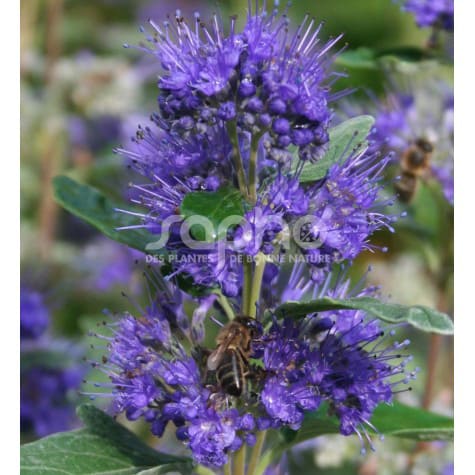
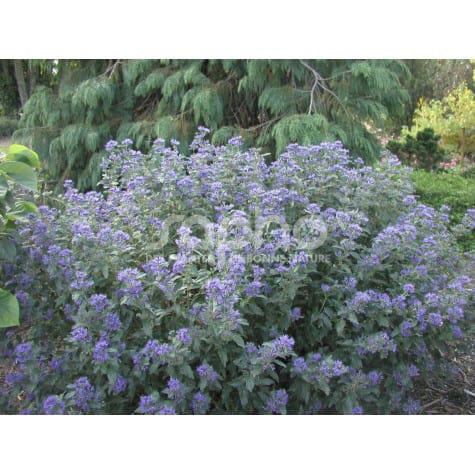
The bluest of all Caryopteris - GRAND BLEU® has been a STAR shrub for nearly 15 years.
GRAND BLEU ® is a dense, bushy rounded shrub. Its growth is regular. It is suitable for container growing.Its abundant and late flowering spreads from August to October. The flowers have long stamens and are of a remarkable deep dark blue, which is highlighted by the bright, dark green characteristic foliage. Like all Caryopteris, the foliage gives off a turpentine smell when touched.GRAND BLEU ® attracts attention, when it is associated with shrubs or brightly coloured perennials. It is very suitable for planting in large quantities in public spaces, or as a sole shrub in gardens of moderate size.
Trophies:
Bronze medal at PLANTARIUM 2007 (Boskoop - Netherlands)
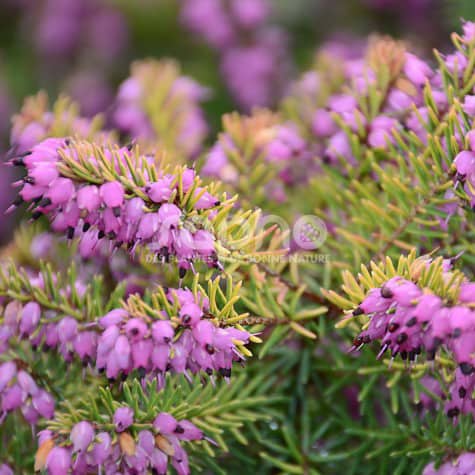
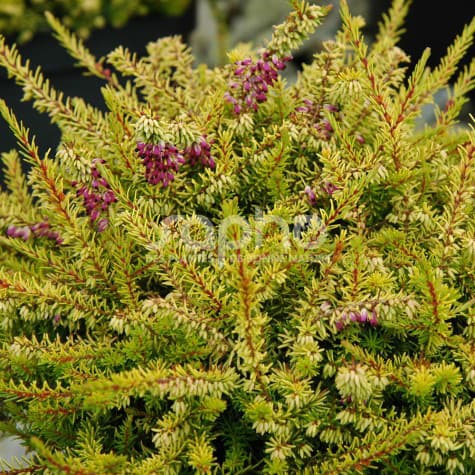
A precious heather for the garden.
Mutant of the well-known variety 'Kramer's Rote', 'Eva Gold' possesses all its qualities: rapid growth, rounded and compact shape, long-lasting and abundant red flowers in the middle of winter for an Erica type heather.
The colour of its foliage has the particularity of changing throughout the year, from the light green new growth, turning golden yellow in summer, again becoming pure green in winter.
Attractive individually or in large groups, possibly planted with other heathers, 'Eva Gold' will embellish borders and slopes, as much with its remarkable flowers from November to March, as with its bright yellow colour in summer, which does not fade in the sun. It can also be planted in pots.
Trophies:
Praised by the Boskoop observation station (NETHERLANDS)
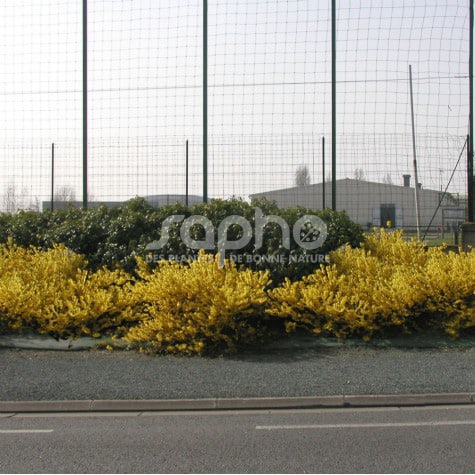
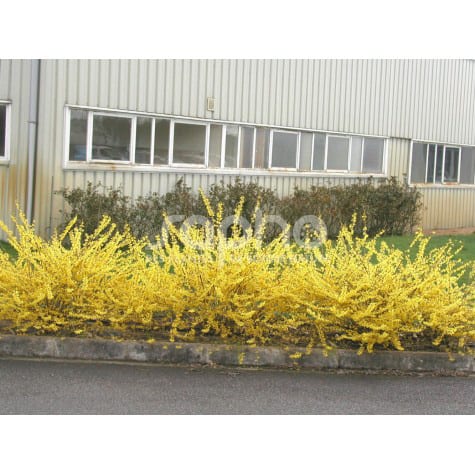
The first ground-cover Forsythia is still a STAR !
MAREE D'OR ®, about 0.80 m high and 1.50 m wide, layers naturally and as such has all the qualities of a good ground cover.Its grapefruit yellow, abundant flowers are early, in February - March, depending on the regions and climate. It flowers on the previous year's stems.The light green foliage comes after the flowers and completely covers the stems.Because of its principal function as a ground cover, MAREE D'OR ® can be used grouped on banks, guide islands, roundabouts and their green areas, using 1 plant per square meter. It can stand being planted on slabs, in containers and flower boxes.
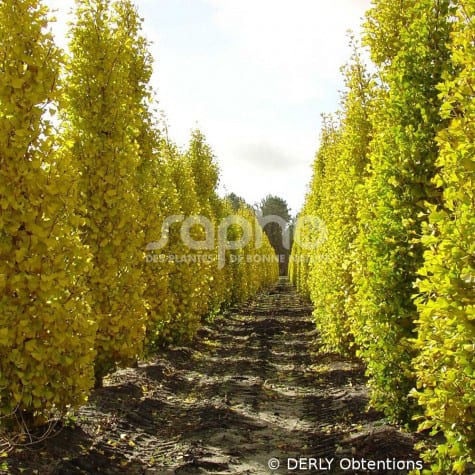
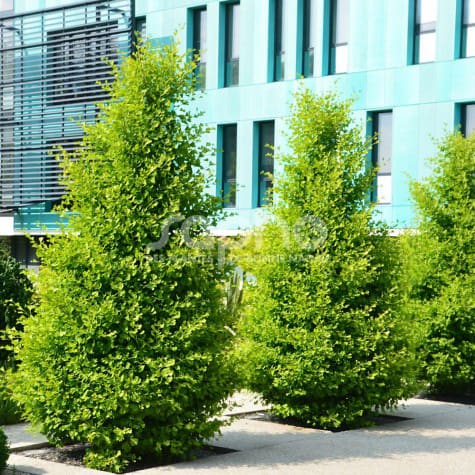
The pyramide shaped maidenhair tree.
Its moderate dimensions and its pyramide shaped even growth allows this beautiful Ginkgo selection to be used in gardens, planted in rows and grown in large containers.'Blagon' is spectacular in the autumn due to its golden yellow colour. For 30 years, the original stock plant has still not told the secret of its «flowers», meaning we still don't know if it is a male of female tree.It is rustic, resistant and adapts well to urban conditions.
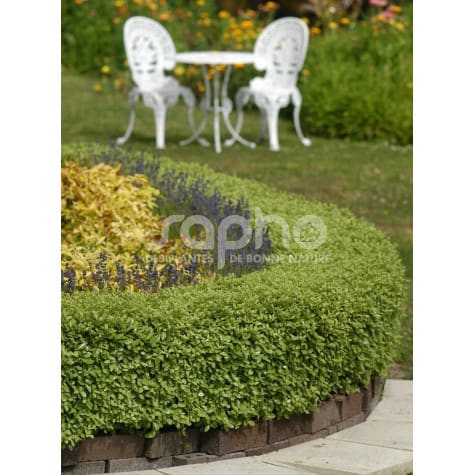
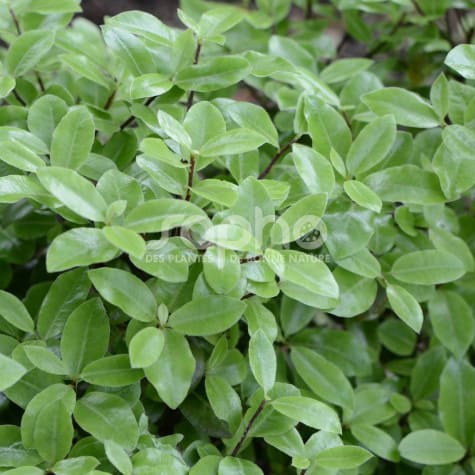
Recommended for its low, naturally ball shaped growthThis cultivar originates from New Zealand.?Golf Ball? has a very round shape, not more than 1 m in dimension. It grows rapidly and stands out by its dense branches from the base upwards.Its evergreen foliage is light green.Discrete violet-brown flowers appear in Mai and June. The have a scent of honey but are of no decorative interest. 'Golf Ball' resists rather well to drought, and to temperatures of -5 to -10° C. It is excellent for the sea side because it accepts mist and wind.Recommended for small areas and low hedges, it is also suitable for pots and as topiary, like box.
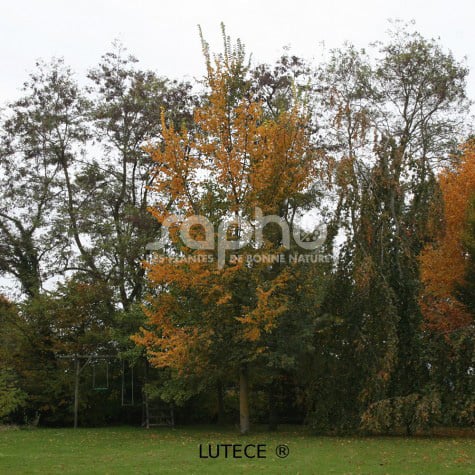
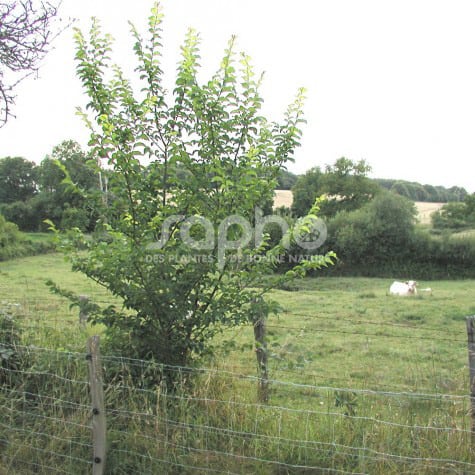
Resistant to the Dutch elm disease, our towns and countryside have found the elm again.
Tested by INRAE, this hybrid is the result of cross fertilization of six French varieties, plus an English and a Chinese one. It is resistant to the Dutch elm disease.Its bark is smooth. The leaves are quite similar to the common elm tree: asymmetrically toothed, with a rough underside. The deep green foliage is dense. In the autumn it has a beautiful golden yellow tint.In March, before the leaves, grow discreet flowers in the shape of little red globules without petals.Its slender trunk gives LUTECE® a perfect aptitude for a high-stem training, better than Ulmus RESISTA® 'Sapporo Gold'; growing naturally its habit is regular and homogeneous. It also makes a very good shrub. It is fast growing.Perfectly adapted to landscape hedges, this cultivation is equally interesting planted in groups on an embankment for example, but also as individual tree or grown in line if it has been grown as a full standard.The name of LUTÈCE® was given to it in recognition of the help provided by Parks and Gardens Department of the city of Paris for having taken care of a field of experimentation in the Vincennes Park.