

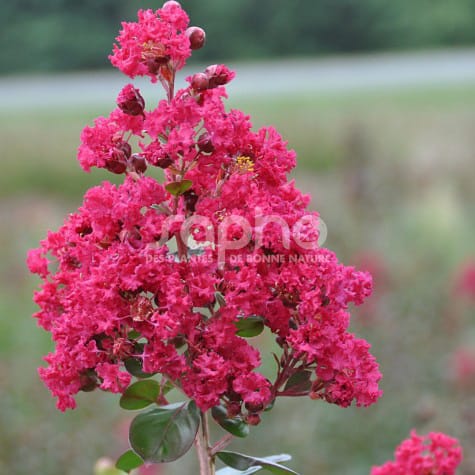
A very early fire-red in the INDIYA CHARMS® range.The very early flowering is remarkable because of its very dense, good-sized, intense red thyrses, from the beginning of July onwards; in the right conditions, there is new flowering at the end of summer. The young red shoots are followed by dark green foliage.BRAISE D'ÉTÉ®, CAMAÏEU D'ÉTÉ®, FUCHSIA D'ÉTÉ® and VIOLET D'ÉTÉ® are the four varieties of the INDIYA CHARMS® range in our program. They offer pretty shades of mauve, violet, pink and red, adding bright summer colours to shrub borders and mixed hedges. Stem-grafted, in pots or in the ground, they decorate any entrance, terrace or, more traditionally, can be planted in a row.They can also be trained along a south facing wall.
Filter By
Foliage
Where to find Sapho plants ?
For young plants
You will find the names of Sapho-licensed nurserymen at the bottom of each variety sheet.
For available plants
Please ask your nursery suppliers.
Each licensed propagator is free to market his young plants to all his customers.
Categories
Menu
All our varieties
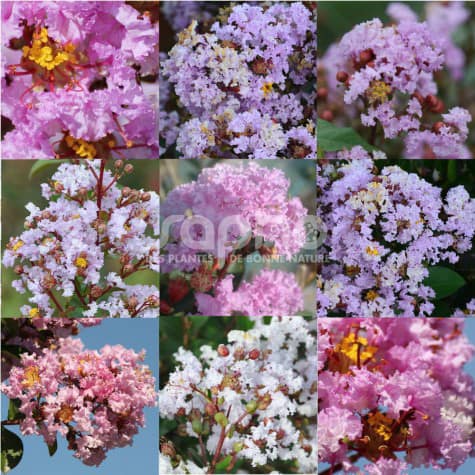
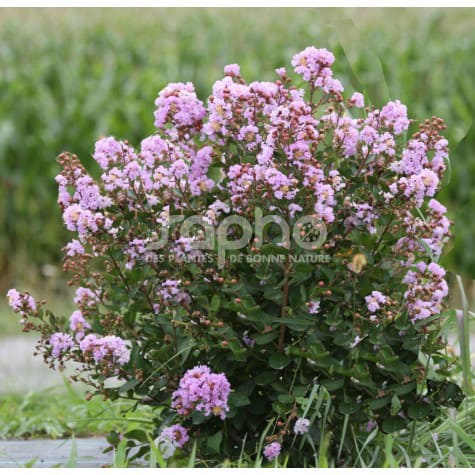
The earliest variety of the INDIYA CHARMS® range.
The earliest cultivation of this range offers a cameo of pretty white to mauve coloured flowers and has small leaves and a dense shape.BRAISE D'ÉTÉ®, CAMAÏEU D'ÉTÉ®, FUCHSIA D'ÉTÉ® and VIOLET D'ÉTÉ® are the four varieties of the INDIYA CHARMS® range of our program. They offer pretty shades of mauve, violet, pink and red, adding bright summer colours to shrub beds and mixed hedges. Stem-grafted, in pots or in the ground, they decorate any entrance, terrace or, more traditionally, can be planted in a row.They can also be trained along a south facing wall.
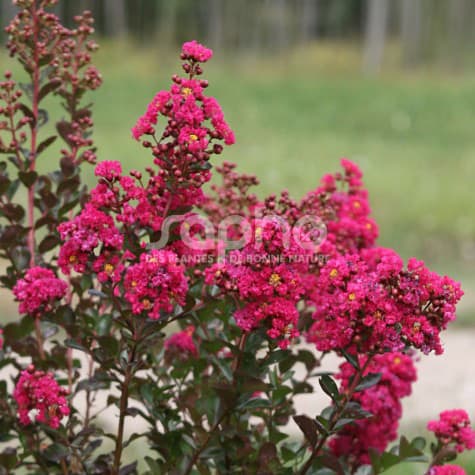
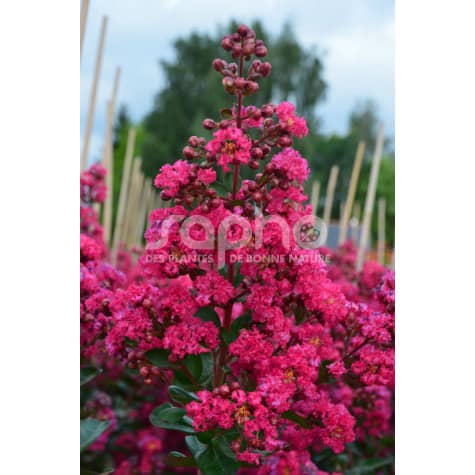
The fuchsia coloured lilac of the INDIYA CHARMS® rangeThe young red shoots make room for big shiny leaves, purple green to bronze, depending on the conditions. The early flowers bloom as very thick fuchsia coloured, nearly red thyrses.BRAISE D'ÉTÉ®, CAMAÏEU D'ÉTÉ®, FUCHSIA D'ÉTÉ® and VIOLET D'ÉTÉ® are the four varieties of the INDIYA CHARMS® range of our program. They offer pretty shades of mauve, violet, pink and red, adding bright summer colours to shrub borders and mixed hedges. Stem-grafted, in pots or in the ground, they decorate any entrance, terrace or, more traditionally, can be planted in a row.They can also be trained along a south facing wall.
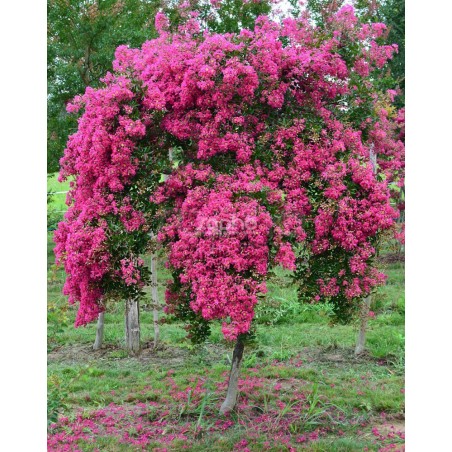
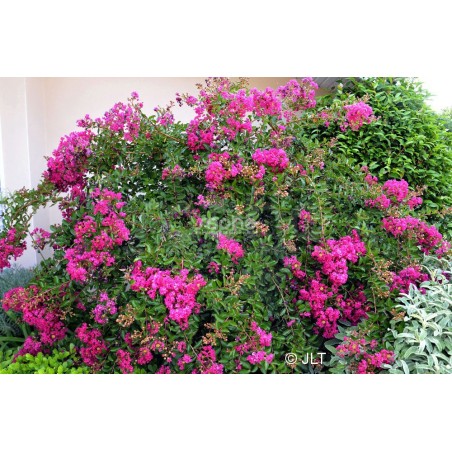
MIMIE® Fuchsia: covering growth, prolific bright flowers, early and long lastingThis Lagerstroemia variety bred by Alain DABADIE had firstly been chosen for its growth as carpeting ground cover or weeping if the plant is stem trained. The cultivation takes on this shape naturally, without pruning. Further on, MIMIE® Fuchsia 'DABLAGE01' is floriferous right from its early age. It blooms precociously and continues all summer long producing successive new flowers. The 4 cm long florets in the form of remarkable raspberry red grapes can reach up to 30 cm. The flowering season is from mid June to mid October; these dates vary according to the climate.Finally, this cultivation only needs little or no maintenance. It is a healthy plant, no sensitivity to powdery mildew has been noticed. The novel shape, the precocity, the duration of the bright coloured flowers, it all allows an original use of the crape myrtle, and this even in a wide climatic zone. MIMIE® Fuchsia has its place as ground cover or, when grown as a small standard, is particularly considered for balconies and terraces and at last, more traditionally, in bushy clumps.Trophies: Silver medal at Innovert® 2017 nursery category (Nantes - FRANCE).
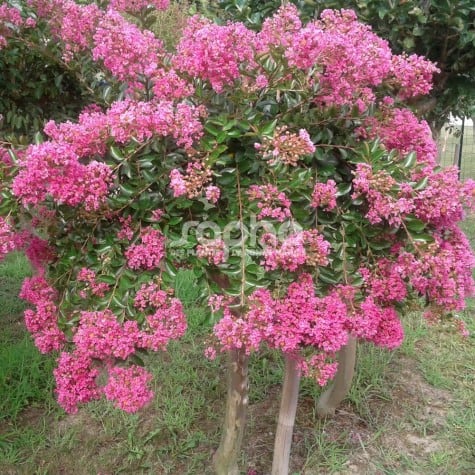
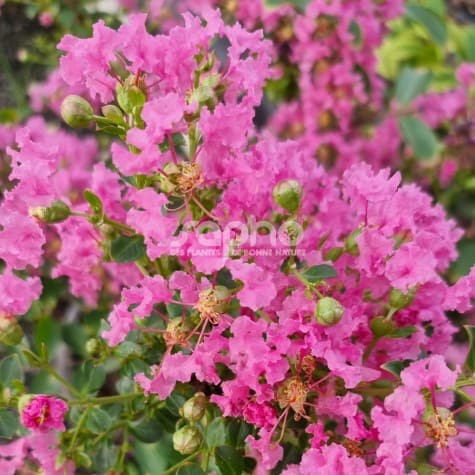
The qualities of MIMIE® Fuchsia lagerstroemia in a pink version
MIMIE® Rose lilac is a compact variety with a horizontal habit, ground-covering or weeping if trained as a stem.
It blooms pink early and remontant all summer long. Its foliage is bright green with a smooth texture.
It is perfect for planting in the ground, as an isolated specimen, in a bed or in a pot, on a terrace or balcony.
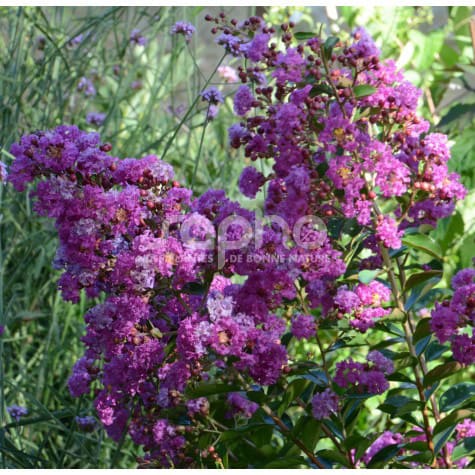
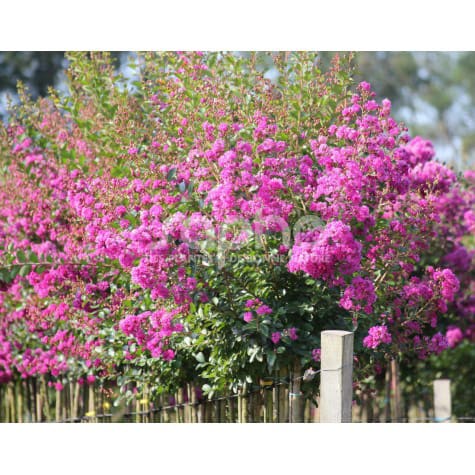
Bright violet in the INDIYA CHARMS® range
This strong growing variety offers early very bright violet flowers, contrasting with the gold-yellow stamens.BRAISE D'ÉTÉ®, CAMAÏEU D'ÉTÉ®, FUCHSIA D'ÉTÉ® and VIOLET D'ÉTÉ® are the four varieties of the INDIYA CHARMS® range of our program. They offer pretty shades of mauve, violet, pink and red, adding bright summer colours to shrub borders and mixed hedges. Stem-grafted, in pots or in the ground, they decorate any entrance, terrace or, more traditionally, can be planted in a row.They can also be trained along a south facing wall.
Trophies:
Bronze medal at Plantarium 2013 (Boskoop - NETHERLANDS)
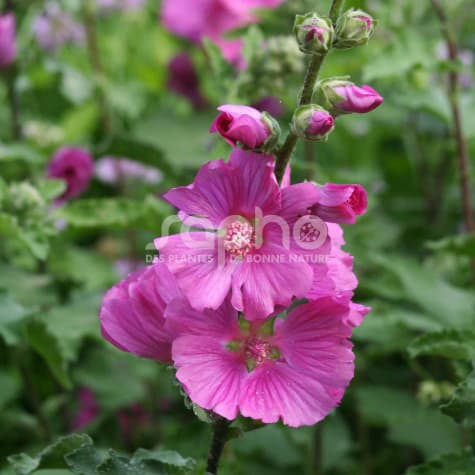
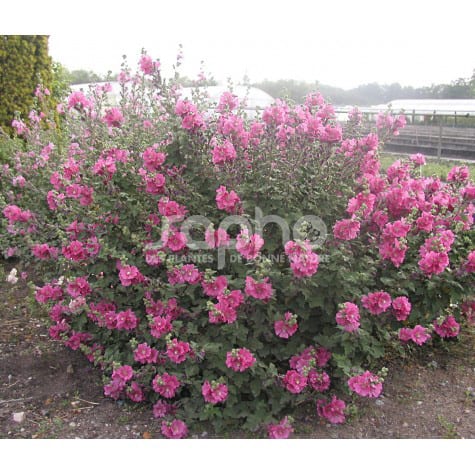
A bright lavatera for the beginning of summer.Deriving from the Lavatera olbia 'Rosea', CHAMALLOW® shows a certain orginality compared to the classic varieties of Lavatera. This selection has a particularly compact, bushy and rounded growth. Its light green, slightly velvety foliage stays healthy. These qualities make it interesting for growing in containers.In July - August, the straight branches have deep pink flowers. They are of medium size with even darker pink stripes.To be planted in flowering hedges or in beds, together with shrubs and perennials.
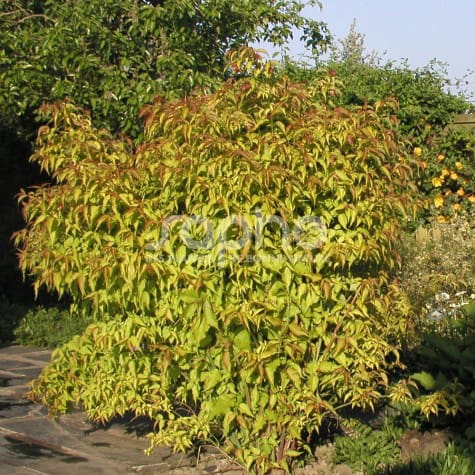

Golden pheasant berryThis vigorous variety of lysteria is of dense and very ramified growth, with fine and graceful wood. Its foliage is semi-evergreen in regions with mild winters and is particularly remarkable throughout spring and summer: the young shoots have a red tint, the foliage stays golden for a long time, turning light green in summer.In July- August, GOLDEN LANTERNS are covered in abundant clusters of flowers with light pink petals turning white with very decorative dark red sepals. They make place for numerous, very ornamental dark red fruits, with purplish black berries. They last long into the autumn and are appreciated by birds.This bright selection should be planted individually, in groups or in a mixed hedge.
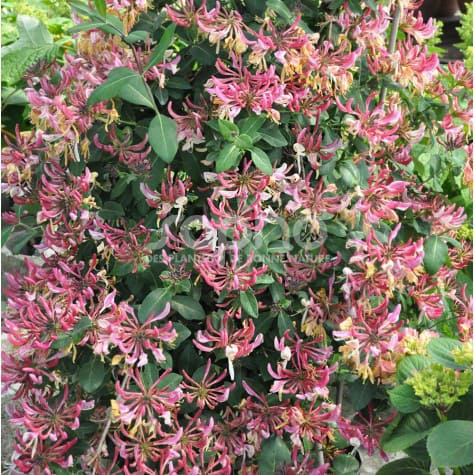
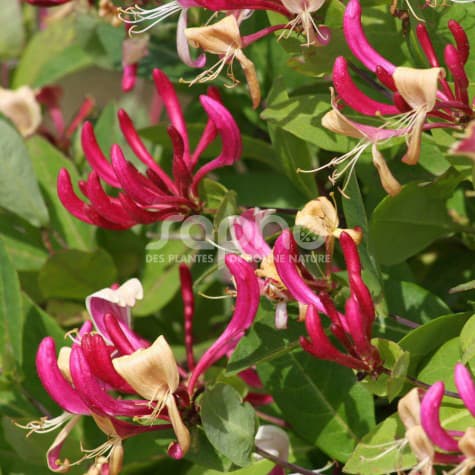
Imperial honeysuckle : an avalanche of beautiful red, fragrant flowers.
This selection of climbing honeysuckle of the CAPRILIA ® range derives from the Lonicera periclymenum 'Florida'. Its growth is medium.From mid June to July this flower bearing variety is particularly remarkable due to its big florets over the entire height of the plant. The fragrant flowers are carmine red in the bud stage, getting lighter on opening, turning cream, then yellow before wilting, producing a beautiful contrast.The dark green foliage shows off the flowers to their advantage. It is resistant to black spot, mildew and aphids.To be trained.
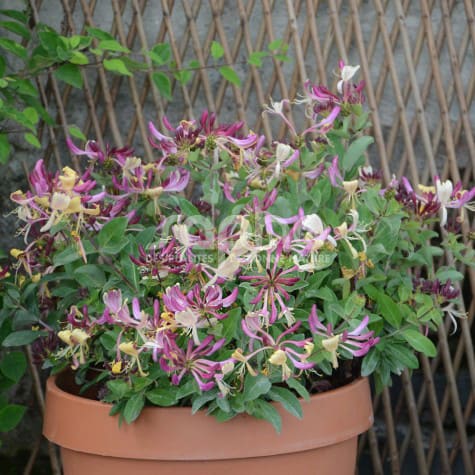
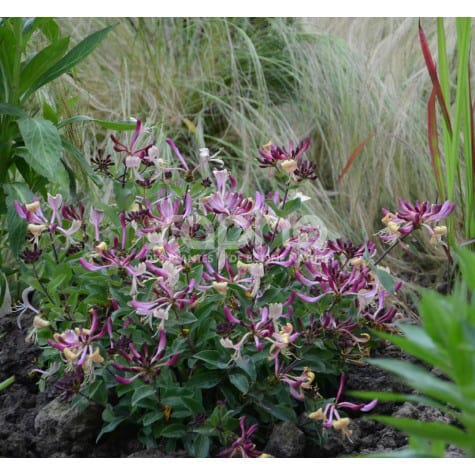
The CHIC of its perfumed flowers and the CHOC of its small silhouette!The "CHIC" : in June, the plant gets covered with very refined flower heads; the purple to deep pink tones of the buds are harmoniously emphasized by the pinkish white and then orangy yellow of the blossomed tubular flowers. This delicately scented cultivation is very floriferous and extends its flowering into September, in good conditions.The "CHOC" : this honeysuckle is surprising due to its dense and reduced growth.The opposite leaves with purple brown petioles have a greeny-blue colour. The shrub is semi-evergreen to evergreen, under temperate conditions.CHIC & CHOC® can be used in pots or planted in the garden.
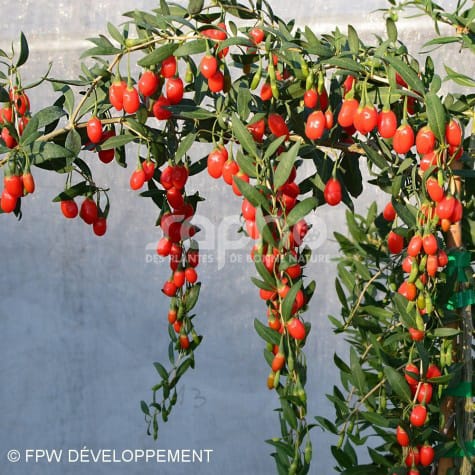
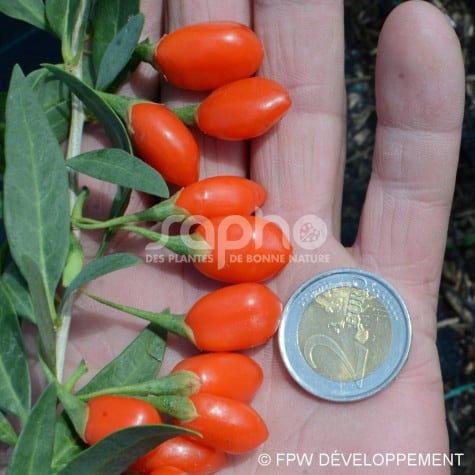
A real innovation from French genetics : An easy maintenance goji with sugary sweet berriesPRINCESS TAO® is an exclusively French genetic goji variety, the outcome of the breeding work by FPW DEVELOPPEMENT.The discrete light violet flowering starts at the end of May. It continues in successive waves right through into September, finally reaching the tips of its branches. The fruits form rapidly and simultaneously. When ripe, the berries are beautifully bright red and shiny. The picking from July onwards is easy as the berries are bigger than those of the currently available market varieties. The fruits are sweet, not astringent and can be eaten fresh or dried. Under good conditions the fruit production continues right into November.From the first year of planting, a small quantity of fruit can already be picked.The naturally layered growth makes staking necessary. Thanks to the sweet taste of its fresh berries and needing only little water, as well as being mildew resistant, PRINCESS TAO® links delicacy and easy maintenance.
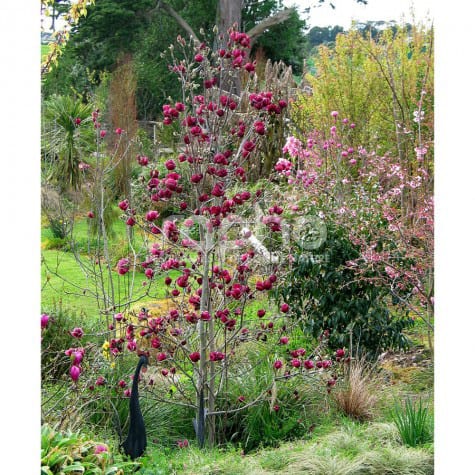
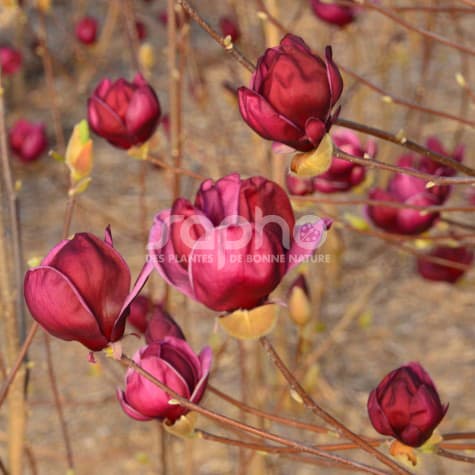
A compact magnolia, with beautiful bright purple tulips.
'Genie' a cross between M. soulangeana and M. lilliflora 'Nigra', has all the qualities of a good hybrid.Right from the beginning, it is very floriferous, and before the leaves appear, it has very big, stable, bright purple, tulip shaped flowers. They are lightly scented, long-lasting, and can resist temperatures of down to -3°C. In good conditions, a second flowering can bloom in summer.Dense and upright growth, good branching, moderate dimensions (at 10 years of age 3 m high and 1.50 m wide) : an asset, planted in small areas, grows as shrub or tree.
Trophies: