
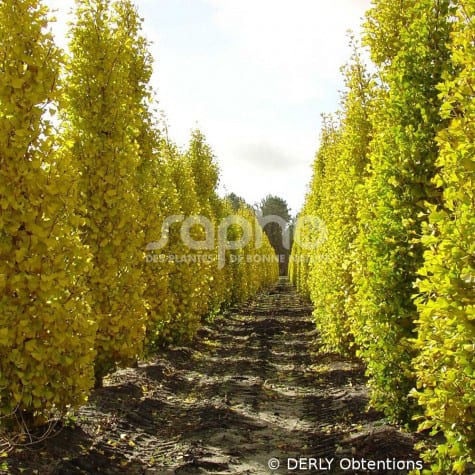
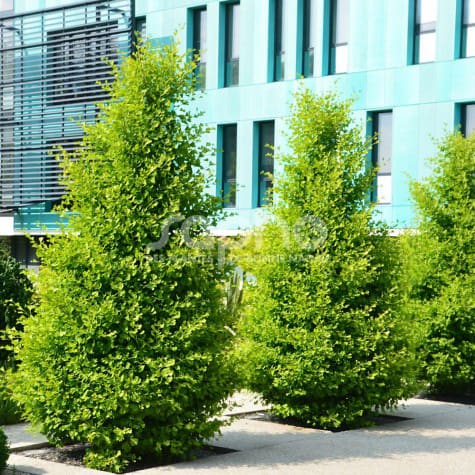
The pyramide shaped maidenhair tree.
Its moderate dimensions and its pyramide shaped even growth allows this beautiful Ginkgo selection to be used in gardens, planted in rows and grown in large containers.'Blagon' is spectacular in the autumn due to its golden yellow colour. For 30 years, the original stock plant has still not told the secret of its «flowers», meaning we still don't know if it is a male of female tree.It is rustic, resistant and adapts well to urban conditions.
Filter By
Foliage
Position
Where to find Sapho plants ?
For young plants
You will find the names of Sapho-licensed nurserymen at the bottom of each variety sheet.
For available plants
Please ask your nursery suppliers.
Each licensed propagator is free to market his young plants to all his customers.
Categories
Menu
All our varieties
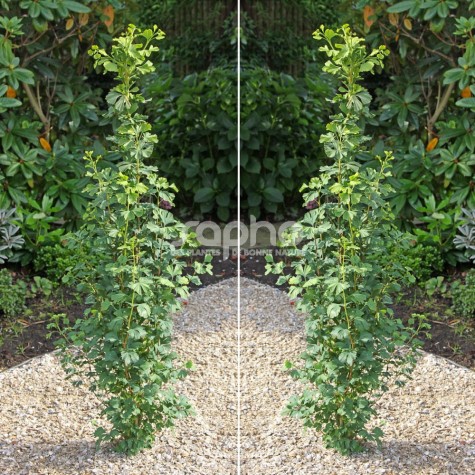
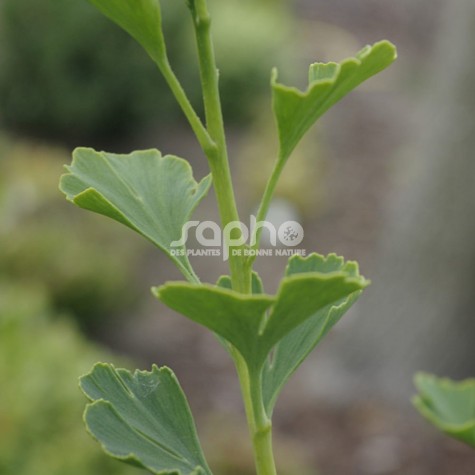
The most narrow of the Ginkgos'Menhir' is of special interest as it is very narrow. Its column shape and its reduced width allow it to be planted in rows or individually, in public parks as well as in smaller gardens.Its growth is vigorous and robust from an early age on.The fairly serrated leaves are of a blue shade of green-grey. Their golden-yellow tint in autumn is long-lasting.A male variety, without production of 'fruit'.
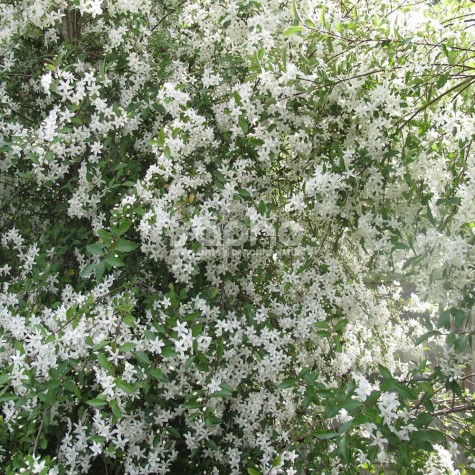
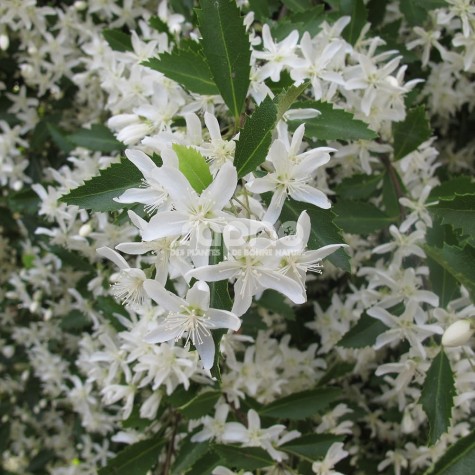
A small, ornamental tree with striking summer flowers
Hoheria sextylosa 'Snow White' is a small tree that keeps its ornamental character throughout the year with its elegant and persistant foliage, its glorious summer flowers and its naturally pyramidal habit. The simple, abundant and delicately perfumed, pure white flowers, resemble those of a cherry tree. The long and clearly toothed leaves are a brilliant green inserted in an attractive, black wood.Hoheria sextylosa 'Snow White' can grow to 4 or 5 metres in 20 years but readily accepts pruning. It may therefore also be used in hedges or maintained as a miniature if necessary.Ideally it prefers a mild, oceanic climate but is nevertheless hardy up to -10°. In colder regions, it's recommended to plant it in sheltered spots, away from cold winds.
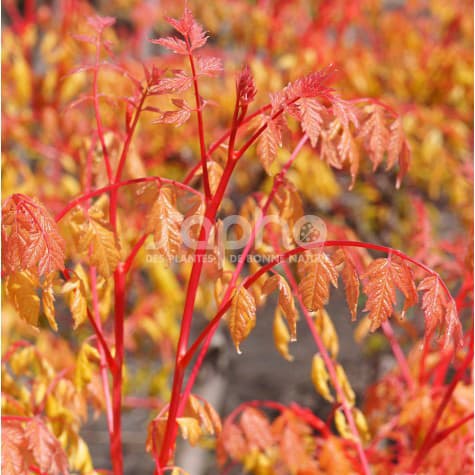
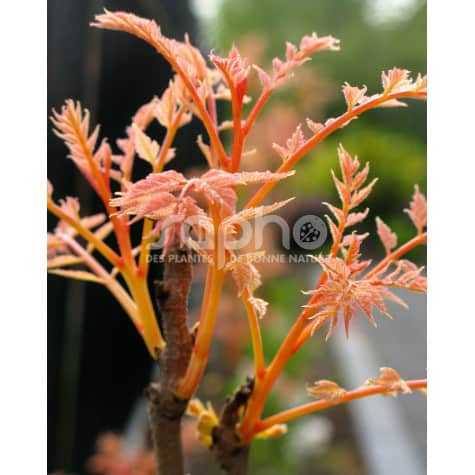
Bright coral - as a tree.
This tree of abour 4 m high is particularly original from spring to autumn.
The spring foliage is of an intense coral. It then takes on a light green tone, contasting with the bright pink to red stalks. Like with the other varieties of soap trees, they are composed and elegantly shaped. The new summer shoots are also coloured, but less flamboyant.
Once the tree is well established, the long yellow grapes of flowers in July are fragrant and very melliferous. They are followed by attractive coral-rose fruit capsules.
Finally the colour of the foliage turns yellow, then orange in autumn.
Grown as small decorative tree or as a bushy shrub, 'Coral Sun' must be planted in a wind-sheltered spot.
Trophies:
Silver Medal at PLANTARIUM 2006 (Boskoop - NETHERLANDS)
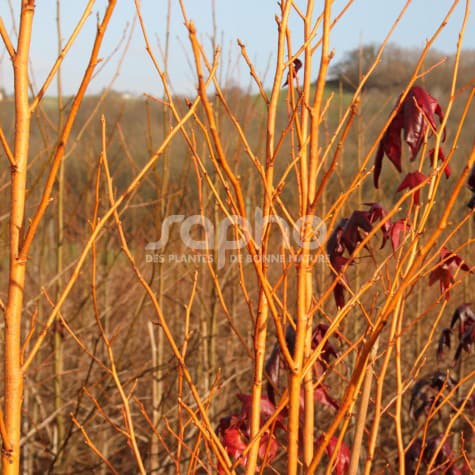
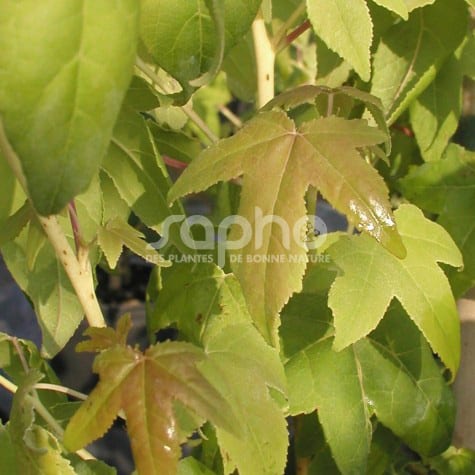
A Liquidambar, bright even in winter.
This tree, which is very original due to its yellow wood, contrasting with its red stalks, is decorative in winter.
Its deciduous foliage, pale yellow in the spring, then green in summer, changes to remarkable red tones in the autumn.
Due to the speed of its medium growth, 'Golden Sun' is a small tree, with an identical shape to the classic American sweet gum tree: even pyramid, with lateral branches growing regularly out of the trunk.
It is as suitable individually grown in smaller gardens, as in rows.
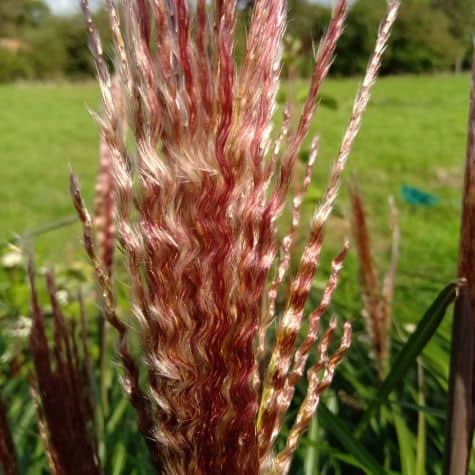
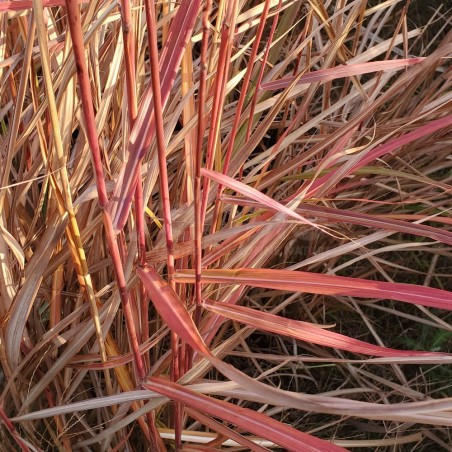
A flamboyant Miscanthus in late summer
This grass has red flowers with pink highlights, appearing in summer and providing a superb contrast to its dark green foliage with silvery-white stripes.
In autumn, the colors of the stems and foliage change to reddish tones.
It's a strong, vigorous plant, with dense branching from an early age.
It can be used as an isolated plant, in a bed or as a plant screen.
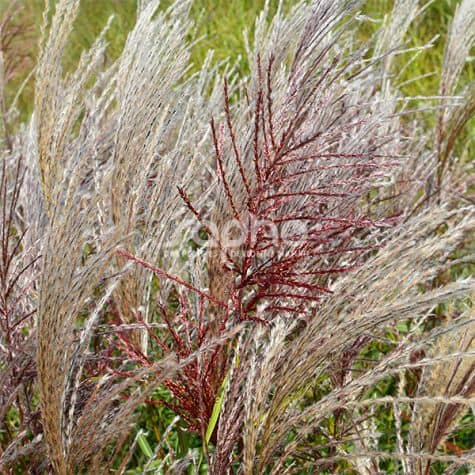
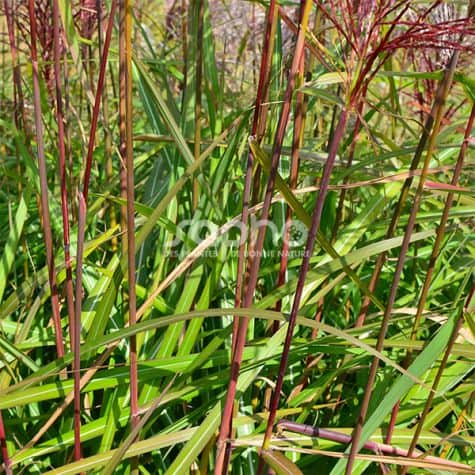
A beautiful red autumn colour that lasts until the coldest weather
This grass has a red spike-like bloom that appears in summer, contrasting with its green, white-ribbed foliage.
In autumn, the foliage and stems take on an intense, long-lasting reddish hue.
Miscanthus can be used in the ground, as an isolated plant, in a bed or as a plant screen.
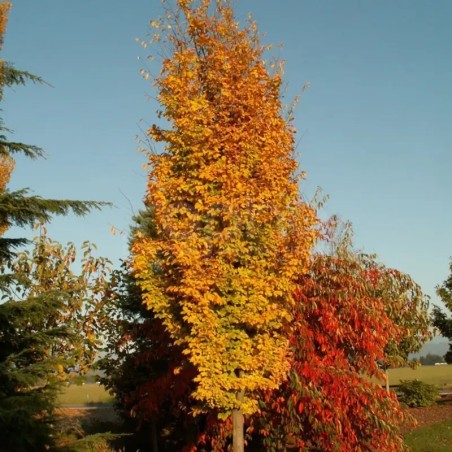

A new asset for urban green spaces
An upright, columnar habit that holds up well with age
Young, tender-green foliage that turns from golden yellow to apricot in autumn, which is highly original for a Parrotia
Robust branches (which withstood the American ice storms)
Its habit, adaptation to different soil conditions and resistance to disease and urban conditions make it ideal for low-maintenance or no-maintenance areas along roadsides or in urban parks
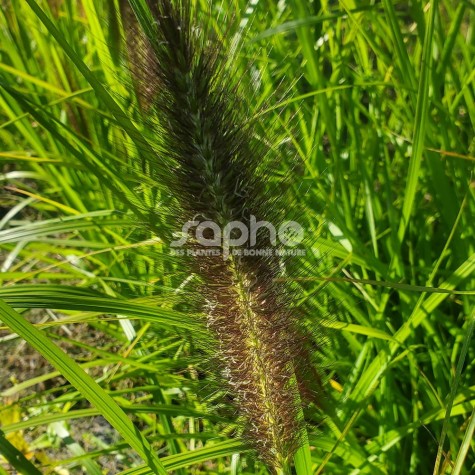
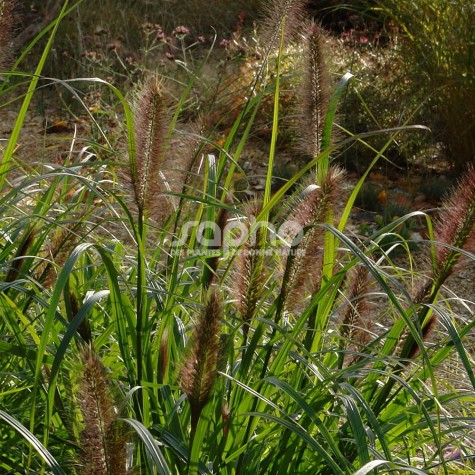
Charming black panicles contrasting with a green foliage
This variety of pennisetum has large, red-tinged spikes that turn purple-black.
The spikes appear abundantly, covering the entire plant from summer to late autumn.
It forms a rounded clump with narrow, glossy green foliage.
Use in beds, in association with other perennials or shrubs.
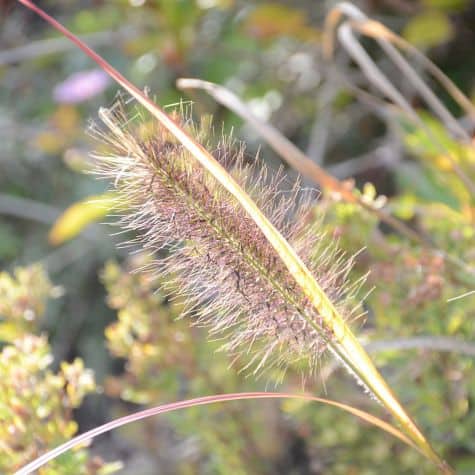
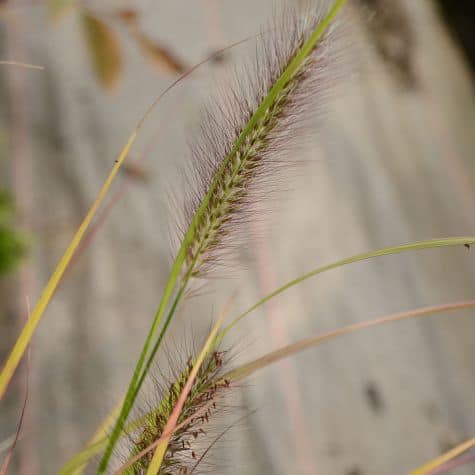
Red-purple green foliage, an original color for a Pennisetum!
This perennial grass's foliage takes on magnificent red hues in late summer and autumn.
Its early flowering remains decorative all summer long, in the form of large spikes.
It has a compact habit, is hardy and requires little water.
It adapts perfectly in combination, in a bed, rockery or tub.
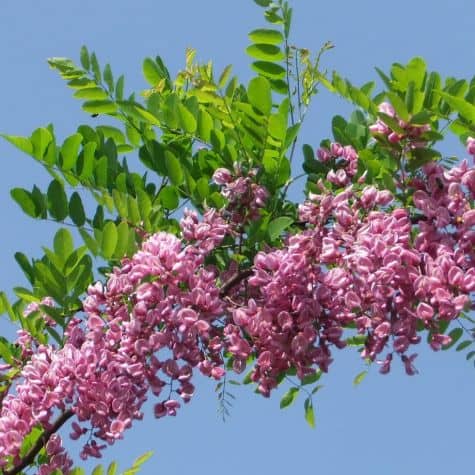
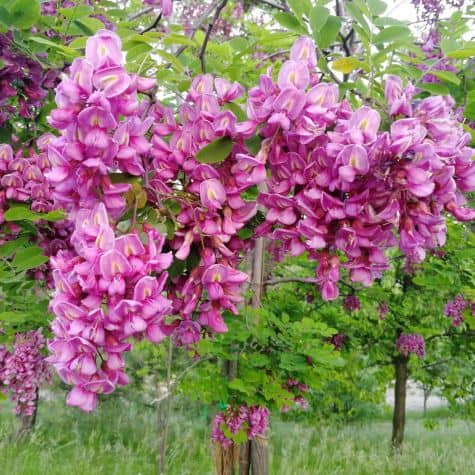
A spectacular improvement of ‘Pink Cascade’
This variety is the result of numerous improvements to the red helmet variety, and has strong, flexible branches (virtually thornless).
Its generous flowering offers large clusters of crimson-pink flowers that are very melliferous.
Resistant to heat, drought, wind and pests, it thrives even in poor soil.
Use as an isolated plant or in the garden.
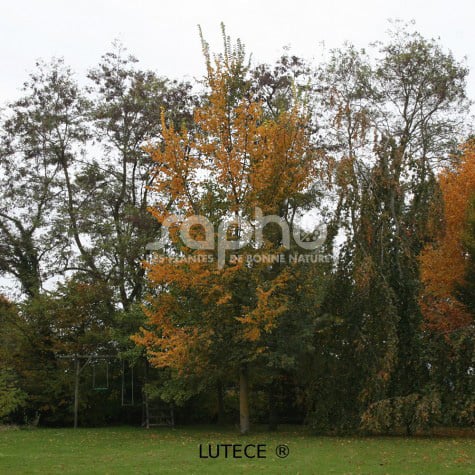
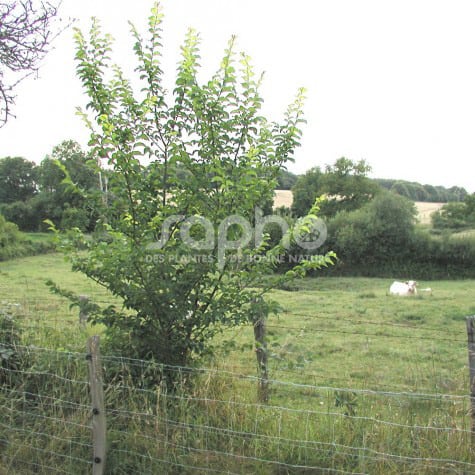
Resistant to the Dutch elm disease, our towns and countryside have found the elm again.
Tested by INRAE, this hybrid is the result of cross fertilization of six French varieties, plus an English and a Chinese one. It is resistant to the Dutch elm disease.Its bark is smooth. The leaves are quite similar to the common elm tree: asymmetrically toothed, with a rough underside. The deep green foliage is dense. In the autumn it has a beautiful golden yellow tint.In March, before the leaves, grow discreet flowers in the shape of little red globules without petals.Its slender trunk gives LUTECE® a perfect aptitude for a high-stem training, better than Ulmus RESISTA® 'Sapporo Gold'; growing naturally its habit is regular and homogeneous. It also makes a very good shrub. It is fast growing.Perfectly adapted to landscape hedges, this cultivation is equally interesting planted in groups on an embankment for example, but also as individual tree or grown in line if it has been grown as a full standard.The name of LUTÈCE® was given to it in recognition of the help provided by Parks and Gardens Department of the city of Paris for having taken care of a field of experimentation in the Vincennes Park.